
I’m just about to start moving into a new office (again!). It’s always exciting to start planning the new layout, this time trying to split a small space between a wood-working section, a robotics/electronics section and, of course, a comfortable desk for coding and writing. I’m looking forward to start making things again!





Autonomous Navigation with LeKiwi — Part 2 [Sponsored]
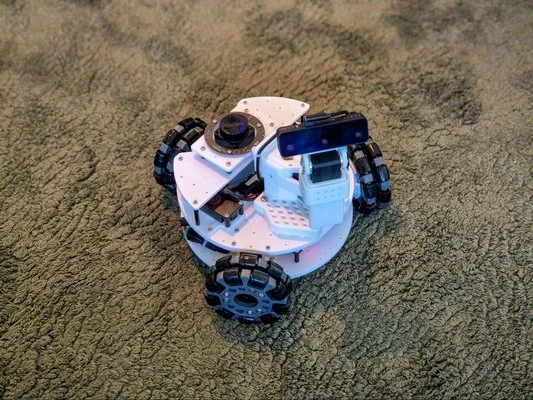
In the last post in our LeKiwi <-> ROS 2 integration series, we are looking into collision-protected teleop, waypoint patrols, and Nav 2 keep-out zones. If you want to jump into Nav2 integration, this blog post is for you!
Chronoplanes and Underground Robot Trains

If you like reading about architecture and solving hard problems, then you will love this write-up by MacCallister Higgins from Pipedream Labs. The article focuses on the hard problem of orchestrating an in-pipe fleet of robots and covers everything from treating pipes as 1-degree graphs to multi-fleet orchestration to a space-time deconfliction engine. And on top of that, all of this needs to support city-scale operations at travel speeds of 100 mph. This is one of the best deep-dives I’ve read in quite a while.
How Much Is Robot Deployment Data Worth?

This piece by Chris Paxton is great, and something I’ve been thinking a lot about lately with regard to robot data. Chris makes a point that robotics deployments are fundamentaly not scalable, and the data produced from these deployments is not scalable, as robotics has a high-dimensional problem space.
vision_pilot

vision_pilot by the Autoware Foundation is an open-source L2 ADAS implementation. The current system supports a single front-facing RGB camera with 1-2MP resolution. I find this stack to be an interesting alternative to Open Pilot, although poking around the repository, I’m not sure vision_pilot is meant to be used by individual users.
Xiaomi-Robotics-U0

U0 is a “38B autoregressive world foundation model continually trained for embodied intelligence”. It is capable of doing Scene generation, embodied transfer, video generation, and more, resulting in a single foundation model for robot-centric generation. To learn more about this work, check out this paper.
Sheet-to-Sky: Design and Flight Validation of a Flat-Packable Cardboard Wing

Researchers from the AIR Lab at SUTD created a flat-packable cardboard fixed-wing drone. Nice idea!
NVIDIA increases the price of Jetson modules and devkits by up to 101%

This is not the typical news you would see in our newsletter, but I thought I would mention this since many of us depend on NVIDIA platforms for compute.
U.K.-based Humanoid secures $152M in Series A funding

We have a new Unicorn!
Humanoid, an AI and robotics company building industrial humanoids, today announced a $152 million Series A financing at a $1.35 billion post-money valuation.
Our Sponsors
- Card79 helps robotics companies accelerate deployment and adoption by designing every human touchpoint between people and autonomous systems—from industrial design and interfaces to human-robot interaction.
- Foxglove is a purpose-built, modular platform for robotics teams to collect, organize, and learn from vast quantities of multimodal data, creating the data flywheel to safely scale from development to distributed fleets
- Jiga connects hardware teams directly with vetted manufacturers for reliable capacity from prototype to production, combining the speed of digital manufacturing with the trust of a long-term supplier relationship
- Point One Navigation delivers centimeter-accurate positioning to robots and autonomous systems — powered by the world’s densest fully-owned RTK corrections network.
- Viam is the software platform for building, deploying, and managing robotics applications. Write control logic in your language of choice with well-defined APIs for hardware and services, deploy with built-in OTA updates, and easily scale from prototype to production.
Events
- Actuate 26: Aug 18 - Aug 19, 2026. San Francisco, California, United States of America
- Commercial UAV Expo: Sep 01 - Sep 03, 2026. Las Vegas, Nevada, United States of America
- Autonomy: Sep 14, 2026. Malmö, Sweden
- ROSCon Global: Sep 22 - Sep 24, 2026. Toronto, Canada
- Open Source Summit: Oct 07 - Oct 09, 2026. Prague, Czechia
- ROSCon UK 2026: Oct 21 - Oct 23, 2026. Edinburgh, United Kingdom
- ROSCon Spain 2026: Oct 27 - Oct 28, 2026. Valencia, Spain
- ROSCon BE 2026: Nov 25 - Nov 26, 2026. Nivelles, Belgium
- Humanoids 2026: Dec 06 - Dec 09, 2026. Santa Clara, California, United States of America
For more robotic events, check out our event page.
Want to promote your product or service in Weekly Robotics? Check out our advertising options.