
Last week, I spent a lot of time using ACT and LeRobot to train a robot to pass butter (see my result). All in all, I found the process quite enjoyable, but I was surprised by how slowly the inference ran on my M1 Mac. Adding logging constrained the system so much that the model failed. I might look into it more in the near future, but it was quite an eye-opener for these simpler models. I’m looking forward to presenting my work at WawTech later this week!




Open-Source World Models for Robotics and Physical AI [Sponsored]
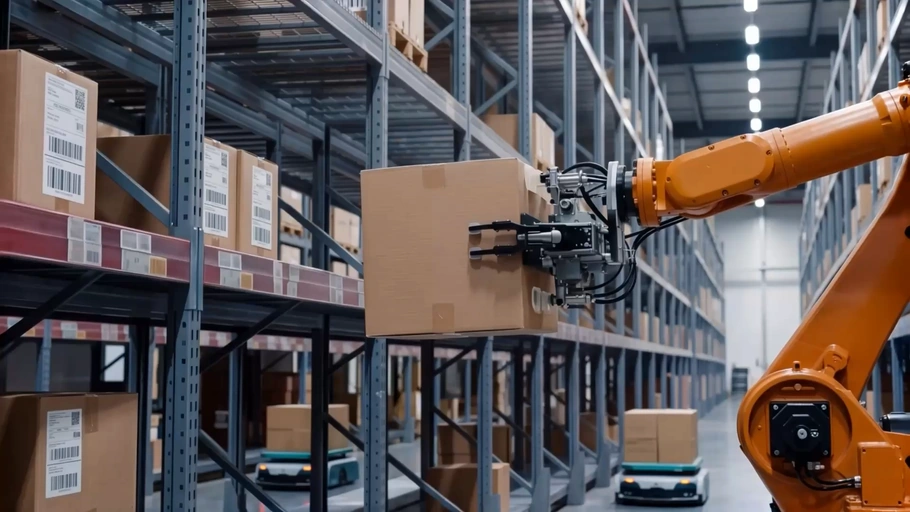
Training robots requires more data and environmental variation than real-world collection alone can provide. LTX-2.5 offers an open-weights foundation model with a dedicated pretrained checkpoint for physical AI applications. Generate synthetic training data, fine-tune on your own environments, and run simulations on infrastructure you control.
Teaching robots to carve marble sculptures

Eleanor Wiesler from Monumental Labs wrote an excellent technical breakdown of their autonomous marble-carving system. The team uses KUKA KR240 industrial robots to transform 3D models into physical sculptures. Rather than manually programming toolpaths, their pipeline generates them automatically using voxel representations, signed distance fields, geodesic distances, and optimization. I recommend checking out the video at the top of the blog post that shows bunny carving!
AHEADance: Anticipatory Humanoid Dance from Streaming Audio

Researchers at UCL have developed a system that lets a Unitree G1 humanoid dance to music as it’s playing. The challenge is that the robot must plan its movements before hearing the next part of the song. AHEADance uses a music model to predict upcoming beats and a motion generator trained to continue from its previously executed movements. The results shown on G1 are impressive.
Building A Robotic Hand On A Budget

Here is an impressive tendon-driven robot hand that costs $300 in parts. The tendons are built from thin steel wire that’s routed through PTFE tubes to reduce friction.
Alloy

Alloy is a physics engine for robot learning, built on Newton, MuJoCo Warp and Warp: rigid bodies and robots step in MuJoCo Warp (MuJoCo C on the CPU), cloth and soft bodies in Newton’s VBD, sand and pastes in Newton’s MPM, liquids in Alloy’s own DFSPH. One scene can hold rigid robots (sub-millimetre contact for declared precision fits such as pegs and threads), cloth and soft bodies, liquids, granular material, cables and objects that cut or tear, stepped together in parallel worlds on one NVIDIA GPU: thousands for free rigid bodies, 512 to 4,096 for a robot arm (on one L4, a Franka Panda with a table and a cube ran best at 2,048), tens to hundreds with cloth or liquid.
Play2Perfect

We mentioned this project last week, but thought it deserves its own feature. Play2Perfect explores a simple idea: before teaching a robot precise assembly, let it learn how to manipulate objects through play. The website contains a nice web-based simulator. I recommend checking it out!
A Pen Plotter To Draw You Up (on) The Wall

Nik Ivanov built Mural 2.0, a wall-climbing pen plotter that uses two NEMA 17 stepper motors to draw large murals. The motors are mounted directly on the moving robot, which climbs using a belt anchored near the ceiling. An ESP32 runs FluidNC and controls motion via TMC2209 stepper drivers. This project gave me quite a bit of FOMO. Would love to build one of these!
My Kids vs. a $3,400 Robot Mower

As someone who aspires to have a mower one day, I enjoyed this comparison of a Luba 3 AWD mower with more conventional mowers. One caveat: the video has a promotional feel, so take the cost comparison with a grain of salt.
French robot maker Genesis raises $500 million at $3.5 billion valuation

French robotics startup Genesis AI has raised $500 million in a funding round valuing it at $3.5 billion, the company said on Tuesday, one of the biggest funding rounds in Europe’s robotics sector as investors bet on demand for AI-enabled factory robots.
Our Sponsors
- Foxglove is a purpose-built, modular platform for robotics teams to collect, organize, and learn from vast quantities of multimodal data, creating the data flywheel to safely scale from development to distributed fleets
- Jiga connects hardware teams directly with vetted manufacturers for reliable capacity from prototype to production, combining the speed of digital manufacturing with the trust of a long-term supplier relationship
- Point One Navigation delivers centimeter-accurate positioning to robots and autonomous systems — powered by the world’s densest fully-owned RTK corrections network.
- LTX is a lab for building frontier open world models, developing open-weight multimodal models that understand physical space, causality, and structure.
Events
- ROSCon BE 2026: Nov 25 - Nov 26, 2026. Nivelles, Belgium
- Humanoids 2026: Dec 06 - Dec 09, 2026. Santa Clara, California, United States of America
For more robotic events, check out our event page.
Want to promote your product or service in Weekly Robotics? Check out our advertising options.