
The other day my daughter received a book with a toy pen that you can point at things in the book, and the pen speaks the names of the objects, sings songs, etc. My first thought was that it must be RFID-based, with chips somehow embedded in the book. To my surprise, when I pointed my phone’s camera at the pen tip, I saw a purple flashing light, which led me down a rabbit hole of figuring out how the damn thing actually works. It turns out, it’s quite clever.
The page is covered by hidden pixels, and each 1 mm2 pattern contains 16 pixels, 9 of which carry actual data defined by an offset from intersecting lines. All the books come preloaded on the pen, and it uses the numeric values read from the pixels to play recordings. I found it quite neat, so I thought I would share!





Robot Hackathon: Fine Motor Skills [Sponsored]
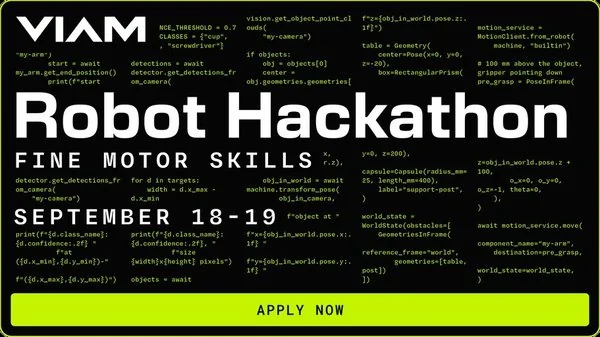
Join us for two days of building an end-to-end robotics application from scratch. Every team gets a real robot arm and a Viam mentor for the weekend — no prior robotics experience required.
Top three teams take home a robot arm each, plus up to $5,000 in Viam credits.
When: Friday & Saturday, Sept 18-19 at Viam HQ in NYC
SKD-1: A Modular Skid-Steer Unmanned Ground Vehicle Platform for Robotics Research

SKD-1 is an open-source UGV with a 5kg payload capacity and a $1,750 BOM. The rover has an STM32-based control board, and all high-level control is based on ROS 2. To build one of those, check out this repo. Big thanks to Guido, our reader, for forwarding this!
CompSLAM

Do you know how to win a DARPA Subterranean Challenge? Of course, by rolling out a winning odometry/SLAM implementation. In this repo, you will find the algorithms implemented by the team from the ETH Zurich Robotic Systems Lab. The work is done in ROS 1, but I’m sure the lessons you can take from this repo are universal. Want more? Check out the paper.
Stay Seated: Learning Omnidirectional Humanoid Locomotion on a Passive Mobile Chair with Casters

I had a very hard time describing this paper, as the title perfectly reflects what you will find inside. Regarding applicability in real-world scenarios? The robots need something to do when waiting for an agent output.
Making A Pole Balance Itself With Propellers

If you are like me and you’ve read the title and thought, “sounds simple, just slap PID on it, and it will work,” it’s not so simple, since the system has oscillations that need to be canceled out. I highly recommend the video featured in the article!
GPT-6 Astra on robotic manipulation

Apparently, the new OpenAI model is really good at robotics! In this article, you will find a comparison of how this model fares on some basic manipulation tasks compared to Anthropic’s Fable 5.1. Although I find this to be a nice demo, I don’t think it would be a solution for general robots. It’s a good reference for thinking about LLM cost when doing robotics - 1 USD per task in the best-case scenario sounds like a lot for any real deployment.
14 Reasons Robotics is Hard

Steve Newman wrote this piece, in which he outlines the problems we need to solve to enjoy truly general robots. If you’ve been in robotics for a while, these points won’t surprise you, but I still find them good food for thought.
Reframe Systems raises $40M to scale its robotic microfactories for home building

Citing the article:
Reframe Systems, a robotics company using physical AI to industrialize home construction, today announced that it has raised $40 million. The company said the funding will help it scale its microfactory network across North America.
Our Sponsors
- Card79 helps robotics companies accelerate deployment and adoption by designing every human touchpoint between people and autonomous systems—from industrial design and interfaces to human-robot interaction.
- Foxglove is a purpose-built, modular platform for robotics teams to collect, organize, and learn from vast quantities of multimodal data, creating the data flywheel to safely scale from development to distributed fleets
- Jiga connects hardware teams directly with vetted manufacturers for reliable capacity from prototype to production, combining the speed of digital manufacturing with the trust of a long-term supplier relationship
- Point One Navigation delivers centimeter-accurate positioning to robots and autonomous systems — powered by the world’s densest fully-owned RTK corrections network.
- Viam is the software platform for building, deploying, and managing robotics applications. Write control logic in your language of choice with well-defined APIs for hardware and services, deploy with built-in OTA updates, and easily scale from prototype to production.
Events
- Autonomy: Sep 14, 2026. Malmö, Sweden
- ROSCon Global: Sep 22 - Sep 24, 2026. Toronto, Canada
- Gravis Robotics x Foxglove: Zurich Robotics Night: Sep 29, 2026. Zürich, Switzerland
- FUSE Toulouse 2026: Oct 06, 2026. Toulouse, France
- Open Source Summit: Oct 07 - Oct 09, 2026. Prague, Czechia
- ROSCon UK 2026: Oct 21 - Oct 23, 2026. Edinburgh, United Kingdom
- ROSCon Spain 2026: Oct 27 - Oct 28, 2026. Valencia, Spain
- FUSE San Francisco 2026: Nov 19, 2026. San Francisco, California, United States of America
- ROSCon BE 2026: Nov 25 - Nov 26, 2026. Nivelles, Belgium
- Humanoids 2026: Dec 06 - Dec 09, 2026. Santa Clara, California, United States of America
For more robotic events, check out our event page.
Want to promote your product or service in Weekly Robotics? Check out our advertising options.