
Over the last couple of weeks, I've been receiving lots of feedback about the redesign of this newsletter. I greatly appreciate all these insights, and I'm hoping to have some time to implement this feedback soon! If there is anything you'd like to add, feel free to drop me a message! Now, let's look at some cool projects!



sowbot
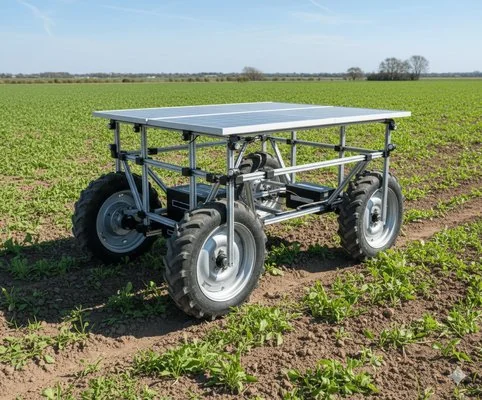
Sowbot is an open-source agricultural mobile robot with an open-hardware brain that uses ROS 2. The compute is split between two boards handling different tasks, and the system uses dual GNSS RTK receivers for positioning. The huge 800W hub motors are an interesting design choice. I’m looking forward to seeing this project grow!
Creating the World’s Most Efficient Drone

Luke Maximo Bell has been featured in Weekly Robotics on many occasions; this time, he documented the process of creating a very efficient multirotor that can fly for 3.5 hours. I love how deeply technical this feature actually is.
FOSDEM Robotics Dev Room Summary
Michael Hart wrote a very nice overview of the FOSDEM 2026 Robotics & Simulation Devroom that yours truly was thrilled to co-organize. Michael made a nice summary of each talk to help you decide which ones to watch.
LDA-1B: Scaling Latent Dynamics Action Model via Universal Embodied Data Ingestion

I’ll be honest, I don’t understand the description of this project, but the demonstrators are super cool!
The 2025 Year in Review – Dronecode Foundation
Dronecode Foundation has released its 2025 report! The ecosystem now supports 110+ targets, which I find very impressive for a single project. Also, having close to 18,000 commits from 99 organizations nicely showcases the project’s maturity.
Mercator: A modular swarm-dedicated robot platform

Mercator is a swarm-dedicated tracked mobile robot. The system runs on a Raspberry Pi 4, supports ROS, and costs EUR 800-1200, depending on the selected setup. To learn more about these robots, check out this video.
Wayve secures $1.5B to deploy its global autonomy platform
Wayve has announced a huge Series D raise to “deploy its global autonomy platform”. Congrats to the team!
Intrinsic joins Google to accelerate the future of physical AI
I have to say, I didn’t have “Intrinsic joining Google” on my 2026 Bingo card. I’m looking forward to seeing how this move plays out and whether we see continued support for ROS from this part of the organization.
Our Sponsors
- Foxglove is a purpose-built, modular platform for robotics teams to collect, organize, and learn from vast quantities of multimodal data, creating the data flywheel to safely scale from development to distributed fleets
- HelloRobo distils robotics tech into simple, usable interfaces
- Jiga connects hardware teams directly with vetted manufacturers for reliable capacity from prototype to production, combining the speed of digital manufacturing with the trust of a long-term supplier relationship
Events
- Embedded World 2026: Mar 10 - Mar 12, 2026. Nuremberg, Germany
- Bots, Bevs and Devs: Mar 11, 2026. San Francisco, United States of America
- European Robotics Forum: Mar 23 - Mar 27, 2026. Stavanger, Norway
- Robotics & Physical AI day (Mashup): Apr 15 - Apr 15, 2026. Malmö, Sweden
- Open Hardware Summit: May 22 - May 23, 2026. Berlin, Germany
- ICRA 2026: Jun 01 - Jun 05, 2026. Vienna, Austria
- 2026 Energy Drone & Robotics Summit: Jun 22 - Jun 24, 2026. Houston, Texas, United States of America
- Robotics: Science and Systems: Jul 13 - Jul 16, 2026. Sydney, Australia
- Open Source Summit: Oct 07 - Oct 09, 2026. Prague, Czechia
For more robotic events, check out our event page.
Want to promote your product or service in Weekly Robotics? Check out our advertising options.